Group wine tour transportation
A wine country day for twelve is not a day for four with more seats. The timing, the winery list and the roads all change — usually in that order.
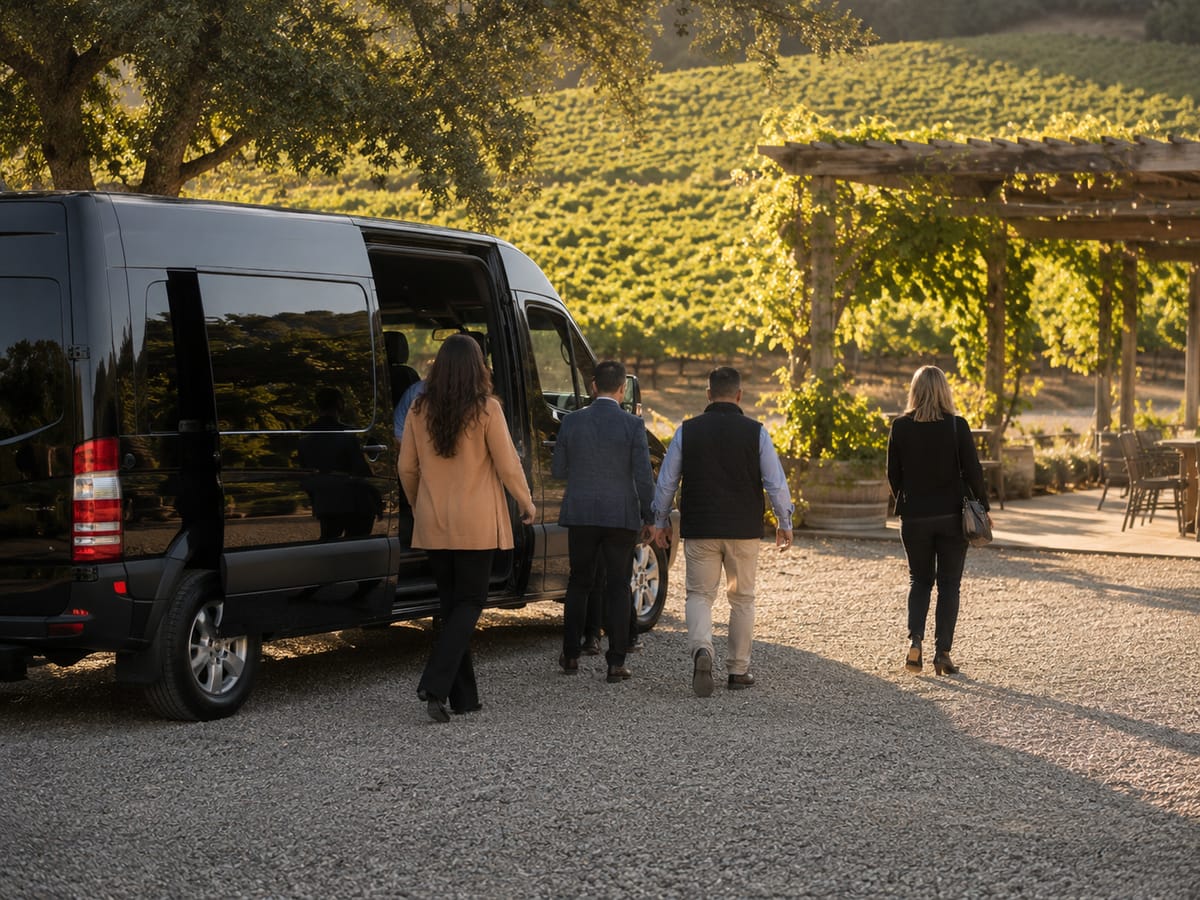
What actually changes as the group grows
Not smoothly — in steps. These are the points at which a wine country day starts behaving differently.
- Two to four
- Everything is easy. Any winery will take you, any vehicle suits, and the day can be improvised. This is the only group size where a fourth tasting is realistic.
- Five to eight
- The first real threshold. Some small tasting rooms start asking whether you have booked, and reassembling after each stop begins to take noticeable time. Luggage and purchases start competing with passengers for space.
- Nine to fourteen
- Now the group needs its own plan. Most estates want advance notice at this size, several will seat you separately from walk-in guests, and a handful will decline. Three stops becomes ambitious; two done well is usually the better day.
- Fifteen to twenty-five
- Winery choice narrows meaningfully, and the itinerary should be confirmed with the venues before anything else is fixed. Larger vehicles also start meeting real constraints on narrow approaches and in small car parks.
- More than twenty-five
- A different kind of day. Most tasting rooms cannot absorb a group this size without arranging something specific, and the transportation usually splits across more than one vehicle. Plan it early — this is not a booking to make three weeks out in October.
These are described by what changes rather than by seat counts on purpose — the threshold that matters is the one where the day starts behaving differently, not the one where a vehicle runs out of belts. Maximum capacities by class are on the vehicles page, with the caveat that seats and luggage compete for the same space.
Where a group's time actually goes
People assume a larger group loses time on the road. It does not, particularly — the driving is the same regardless of how many seats are filled. The time goes at the stops, and it goes quietly.
Everyone getting out. Finding the group a table. Being poured for. Somebody wanting to buy six bottles and having them packed. The two people who have wandered into the vineyard for photographs. None of it is a problem, and all of it adds up across three stops in a way it simply does not for a couple.
The practical consequence is straightforward: plan fewer stops than you think, and put the time back into the ones you keep. Groups who do this describe the day as relaxed. Groups who do not describe it as rushed, and blame the schedule rather than the arithmetic.
One vehicle, or two?
One vehicle, when you can
The group stays together, which for most celebrations and team days is the entire point. Conversations carry between stops, nobody is separated from their friends, and there is one schedule rather than two to keep aligned.
Two vehicles, when the day demands it
Narrow approaches in Dry Creek or the Russian River. A winery that cannot take a large vehicle. Part of the group leaving early for a flight. In those cases two smaller vehicles make a materially better day than one large one — and we will say so.
The size of the vehicle also changes where you can go. This is the constraint groups most often discover too late, and it is much cheaper to design around than to fix on the morning.
The things worth settling in advance
- Confirm group size with the wineries before the route is fixed. Not after. This is the most common reason a group itinerary has to be rewritten.
- Pick one pickup address if you sensibly can. Three hotels is three stops before the day starts, and it always costs more than the map suggests.
- Decide who is keeping time. Someone has to be the person who says "we should head back to the vehicle". Your chauffeur will keep the day moving, but a nominated person in the group makes it painless.
- Leave room for what you buy. Groups buy far more wine than they plan to, and cases take space that was allocated to people.
- Book lunch. Restaurants that can seat twelve without notice are rare at the times you will want them, and an unplanned lunch is where group days lose an hour.
Which region handles groups better?
Napa is more structured, which cuts both ways. Appointments mean a group has a confirmed place to be, and the short distances between tasting rooms make the day easy to keep tight — but you have to book properly and some estates will decline larger parties outright.
Sonoma is more forgiving on formality and has far more outdoor space, which suits a larger, noisier group. The catch is the roads and the distances: a group day in Sonoma needs to commit to one area, and needs a vehicle that can actually get down the lanes in it.
Group wine tour questions
Why can we not fit as many wineries in with a larger group?
Because every stop costs more time than it does with four people. Getting everyone out, seated, served, settled up and back in the vehicle is not much slower per person, but it is a great deal slower per group — and it happens at every stop. Two well-chosen wineries with a proper lunch is a better day for twelve people than three rushed ones.
Will wineries take our group?
Many will, with notice. Some will not, and the ones that will not are frequently the small family estates people most want to visit. This is worth confirming directly with the wineries before the itinerary is fixed — it is the single most common cause of a last-minute rewrite. We can tell you where size is likely to be a problem, but the booking is yours to make.
Should we take one vehicle or two?
One, if the roads and venues allow it — keeping the group together is usually the whole point of the day. Two makes sense when the itinerary runs down narrow lanes, when a winery cannot accommodate a large vehicle, or when part of the group needs to leave at a different time. We will tell you which we would recommend rather than just quoting the cheaper option.
Can we all be picked up from different places?
Yes, but weigh it carefully. Each extra pickup point adds time at the beginning of the day, when the schedule still looks generous and before anyone has tasted anything. For larger groups, gathering at one address is often the difference between a relaxed start and a late one.
What about luggage and the wine we buy?
Tell us at quote stage. A group that fills every seat has nowhere to put cases, and wine country groups buy more than they expect to. It is far better to size the vehicle for people plus purchases than to discover the problem at the second winery.
Does a bigger group need a longer day?
Usually, yes — or a shorter itinerary. The extra time is absorbed at the stops rather than on the road, so adding an hour to the booking often buys back the relaxed feeling that a large group otherwise loses.
Tell us how many of you there are
The headcount, the date, and where you are starting. We will tell you what it fits in, how many stops is realistic, and what it costs.
Request a Group Quote